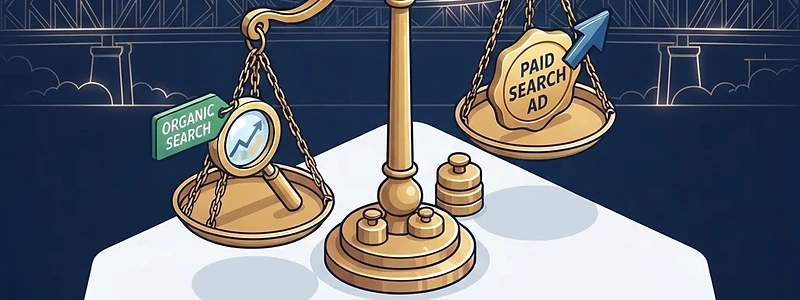
SEO vs Google Ads: Which Is Right for You?
Both drive traffic from Google, but they work in fundamentally different ways. Here's how to choose — and when to use both.
If you're trying to decide between SEO and Google Ads, you're asking the right question — but you might be asking the wrong question. The real answer for most businesses isn't 'which one' but 'how much of each, and when'. Let's break down the differences, the pros and cons, and how to decide what's right for your business.
What's the Difference Between SEO and Google Ads?
Both SEO and Google Ads aim to get your business visible on Google, but they approach it from opposite directions:
Google Ads is paid placement. You bid on keywords, and when someone searches for those keywords, your ad appears at the top of the results (marked 'Sponsored'). You pay for each click. The moment you stop paying, your ads disappear. It's like renting a storefront on the busiest street — fast, reliable, but you're always paying rent.
SEO is earned placement. You optimise your website and content to rank organically in the results below the ads. You don't pay Google for clicks — you earn your position through quality, relevance, and authority. It takes time to build, but once you rank, the traffic is free. It's like owning a storefront on the busiest street — it takes longer to build, but once it's there, you don't pay rent.
Speed: Google Ads Wins
Google Ads can have you on the first page of Google within hours of setting up your campaign. If you need leads this month — not in six months — Google Ads is the answer. For new businesses, time-sensitive promotions, or testing whether a market responds to your offer, Google Ads gives you immediate visibility and immediate data.
SEO takes months. A new website typically takes 3-6 months to rank for competitive keywords, and 6-12 months to achieve strong, stable rankings. If you need results now, SEO alone won't deliver. But if you can wait, SEO builds an asset that pays dividends for years.
Cost: SEO Wins (Eventually)
Google Ads is a pay-as-you-go model. You pay for every click, forever. If you spend $2,000/month on Google Ads, that's $24,000/year — every year. Stop paying, and your traffic stops instantly.
SEO requires upfront investment (typically $1,500-5,000/month for 6-12 months), but once you rank, the traffic is free. Over a 3-year period, a business spending $2,000/month on SEO might spend $72,000 total but then receive free traffic worth far more. A business spending $2,000/month on Google Ads spends the same $72,000 — and the moment they stop, they get nothing.
The smart approach is to use Google Ads to generate leads now while building SEO to reduce your long-term ad spend. As your organic rankings grow, you can reduce your ad budget while maintaining or increasing total traffic — lowering your overall cost per acquisition.
Traffic Quality: It Depends
Google Ads traffic is high-intent — these people searched for exactly what you're offering, and they clicked on your ad. The traffic is immediate, targeted, and measurable. You know exactly what keywords drove each click and can optimise accordingly.
SEO traffic is also high-intent (these people searched and clicked on your organic result), but it's broader. You'll rank for keywords you didn't explicitly target, including informational searches that may not convert directly but build brand awareness and authority. SEO traffic also tends to have higher trust — some users skip ads entirely and click only on organic results.
Control: Google Ads Wins
With Google Ads, you have complete control. You choose your keywords, your ad copy, your landing page, your budget, and your targeting. You can turn campaigns on and off, test different messages, and adjust in real time. If something isn't working, you change it immediately.
With SEO, you're at the mercy of Google's algorithm. You can optimise, create great content, and build authority — but you can't guarantee rankings. Google can change its algorithm overnight and affect your traffic. SEO requires patience and a tolerance for uncertainty.
Google Ads buys you time. SEO buys you freedom. The best businesses use the first to fund the second.
When to Use Google Ads
- You need leads immediately and can't wait 3-6 months for SEO
- You're testing a new market or offer and need data fast
- You're in a highly competitive industry where SEO will take too long
- You have a time-sensitive promotion or seasonal campaign
- You want complete control over your messaging and landing pages
When to Use SEO
- You want to build a long-term asset that compounds over time
- You're in a market where the cost per click is too high for sustainable Google Ads
- You want to reduce your dependence on paid advertising over time
- You have the patience to invest 6-12 months before seeing significant results
- You want to build authority and trust, not just capture clicks
When to Use Both
For most businesses, the answer is both. Google Ads generates leads now while SEO builds organic visibility. As SEO rankings grow, you gradually shift budget from ads to SEO, lowering your overall cost per acquisition. This is the approach we recommend for most clients — it provides both short-term results and long-term value.
The businesses that win don't choose between SEO and Google Ads. They use both strategically, balancing immediate needs with long-term investment. If you're not sure how to balance your budget across both, book a free consultation — we'll help you figure it out.
Not sure whether SEO, Google Ads, or both is right for you? Get a free strategy consultation.
Get a Free Quote→Frequently Asked Questions
Is SEO or Google Ads better?
Neither is inherently better — they serve different purposes. Google Ads is better for immediate results and complete control. SEO is better for long-term value and building an asset that compounds over time. Most businesses benefit from using both: Google Ads for immediate leads while SEO builds organic visibility.
Can I do SEO and Google Ads at the same time?
Absolutely — and you should. They complement each other perfectly. Google Ads generates leads immediately while SEO builds over 3-6 months. As your organic rankings grow, you can reduce ad spend while maintaining total traffic, lowering your cost per acquisition over time.
Does Google Ads help with SEO?
Not directly — Google Ads does not improve your organic rankings. However, the data from Google Ads (which keywords convert, which ad copy works, which landing pages perform) can inform your SEO strategy. Also, appearing in both ads and organic results increases your overall visibility and click-through rate.
How much should I spend on SEO vs Google Ads?
For most businesses, we recommend starting with a higher Google Ads budget (60-70%) and lower SEO budget (30-40%), then shifting toward more SEO as organic rankings grow. By year two, many businesses can balance 50/50 or even lean more toward SEO as organic traffic reduces the need for paid ads.
Let's architect your growth.
Walk away with a written growth plan to keep, whether you work with us or not. Free 30-minute consultation and business audit.